
How Economic News Moves Currency Prices: A Macro Approach
Learn how institutional traders interpret economic news like NFP, CPI, and GDP to predict currency price movements and avoid retail traps.
Quick Answer
The Hierarchy of Economic Data
Not all news is created equal. The forex market operates on a hierarchy of importance when it comes to economic data. These are the reports that have the power to instantly alter central bank policy: * Inflation Data (CPI, PCE, PPI): The absolute most critical data points in modern trading. High inflation forces central banks to raise interest rates, which typically strengthens the currency.
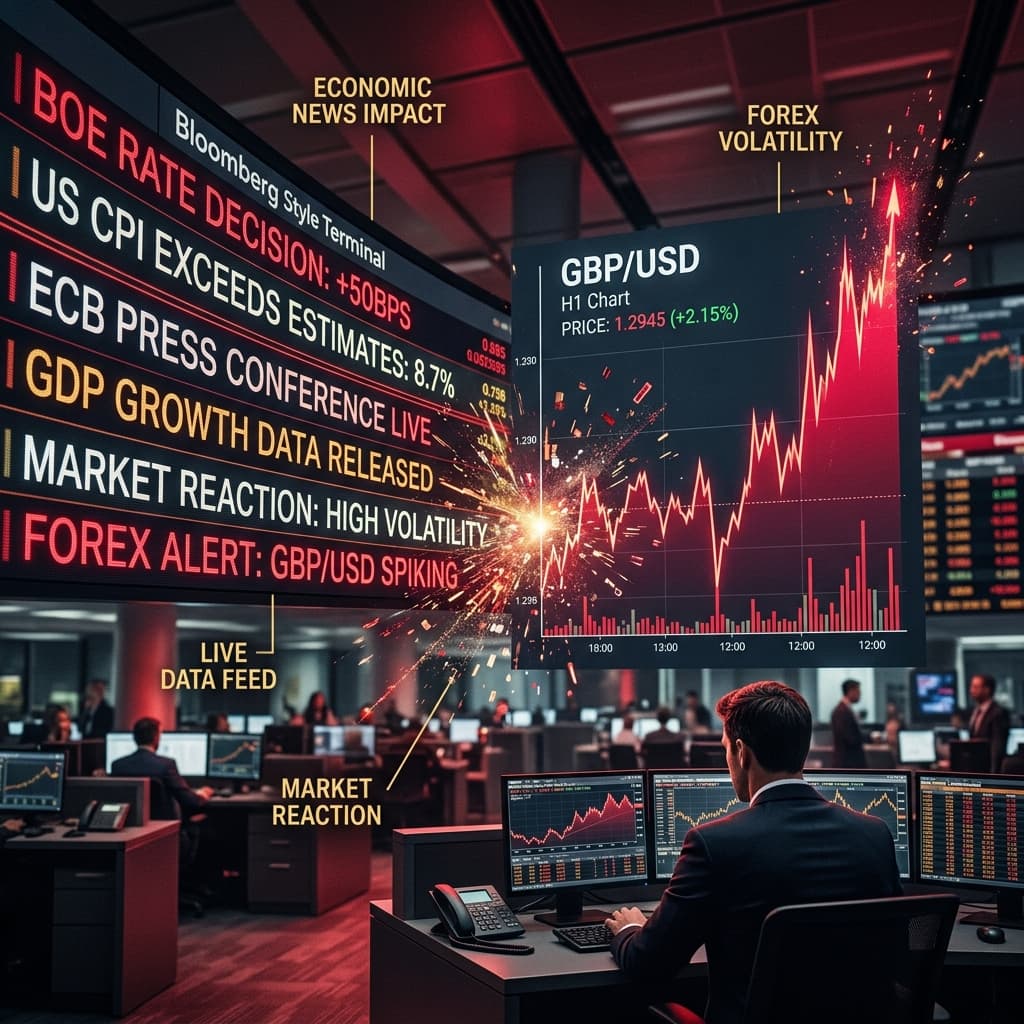
Many retail traders believe that charting patterns and technical indicators alone drive the forex market. However, if you zoom out, the massive structural trends that dictate global currency valuation are entirely driven by Fundamental Economic News.
When major economic data is released, it doesn't just cause a temporary spike on the chart; it causes institutional portfolios worth trillions of dollars to fundamentally re-price the value of a currency.
The Hierarchy of Economic Data
Not all news is created equal. The forex market operates on a hierarchy of importance when it comes to economic data.
Tier 1: The Market Movers
These are the reports that have the power to instantly alter central bank policy:
- Inflation Data (CPI, PCE, PPI): The absolute most critical data points in modern trading. High inflation forces central banks to raise interest rates, which typically strengthens the currency.
- Employment Data (NFP, Unemployment Rate): A strong labor market (like the US Non-Farm Payrolls) gives a central bank the confidence to tighten monetary policy without fearing a recession.
- Central Bank Decisions (FOMC, ECB Rate Statements): The ultimate catalyst, as discussed in our Central Bank Guide.
Tier 2: The Trend Confirmers
These reports indicate the underlying health of an economy:
- GDP (Gross Domestic Product): Measures overall economic growth.
- Retail Sales: Indicates consumer confidence and spending power.
- PMI (Purchasing Managers' Index): A leading indicator of economic health in the manufacturing and service sectors.
The "Priced In" Phenomenon
The biggest mistake retail traders make is trading the number rather than the expectation.
If the market expects US CPI to be 4.0%, and the report comes out exactly at 4.0%, the US Dollar will likely barely move—even though 4.0% is historically high. Why? Because institutional traders had already "priced in" that 4.0% expectation over the previous month.
Volatility only occurs when there is a Deviation from Consensus.
- If the expectation is 4.0% and the actual number is 4.5% (a hawkish surprise), the USD will skyrocket.
- If the expectation is 4.0% and the actual number is 3.5% (a dovish surprise), the USD will plummet.
How to Trade Economic News
Trading exactly at the moment of a news release is extremely dangerous due to liquidity vacuums and slippage. Professional macro traders use a different approach:
- The Fade: Let the initial algorithmic spike happen. Often, the first 5 minutes of a news release produce a wild spike in one direction, only for the "smart money" to step in and aggressively reverse the price back in the direction of the macro trend.
- The Trend Continuation: If the news confirms the existing structural trend, use the initial volatility as an opportunity to enter on a pullback.
- Use Currency Strength: Immediately after a Tier 1 news release, check the Live Currency Strength Matrix. If the US Dollar suddenly jumps from a score of 40 to 85, you have mathematical confirmation that institutional volume is aggressively buying the Dollar across the board.
Frequently Asked Questions
Why did a currency drop when the economic news was good? This is the classic "Buy the rumor, sell the fact" scenario. If traders bought the currency heavily before the news anticipating a good result, they will take their profits the moment the good news actually hits, causing the price to fall.
Should beginners trade during NFP? No. The Non-Farm Payrolls report is notorious for extreme volatility, wide spreads, and slippage. Beginners should close their positions before NFP and wait for the market to settle.
Where can I find an economic calendar? Numerous free financial sites provide economic calendars that rank news events by impact (e.g., High, Medium, Low). Always filter your calendar to only show "High Impact" events for the major economies.
Trade the news with data, not emotion. Track real-time institutional reactions to global economic data using our Live Market Dashboard.
Apply This Knowledge
See It Live on the Currency Strength Meter
Put this analysis into practice. Track real-time momentum across all 8 major currencies — free, no account needed.
Currency Strength Hub Team
CurrencyStrengthHub Editorial & Research Team
The CurrencyStrengthHub Editorial & Research Team comprises seasoned market analysts, quantitative developers, and active traders. We specialize in absolute currency strength models, global macroeconomic analysis, and creating data-driven tools for retail forex traders.