
Forex Market Volatility Explained: Surviving the Chop
Understand the true nature of forex market volatility. Learn how to measure market momentum, avoid choppy conditions, and trade institutional breakouts.
Quick Answer
What is Market Volatility?
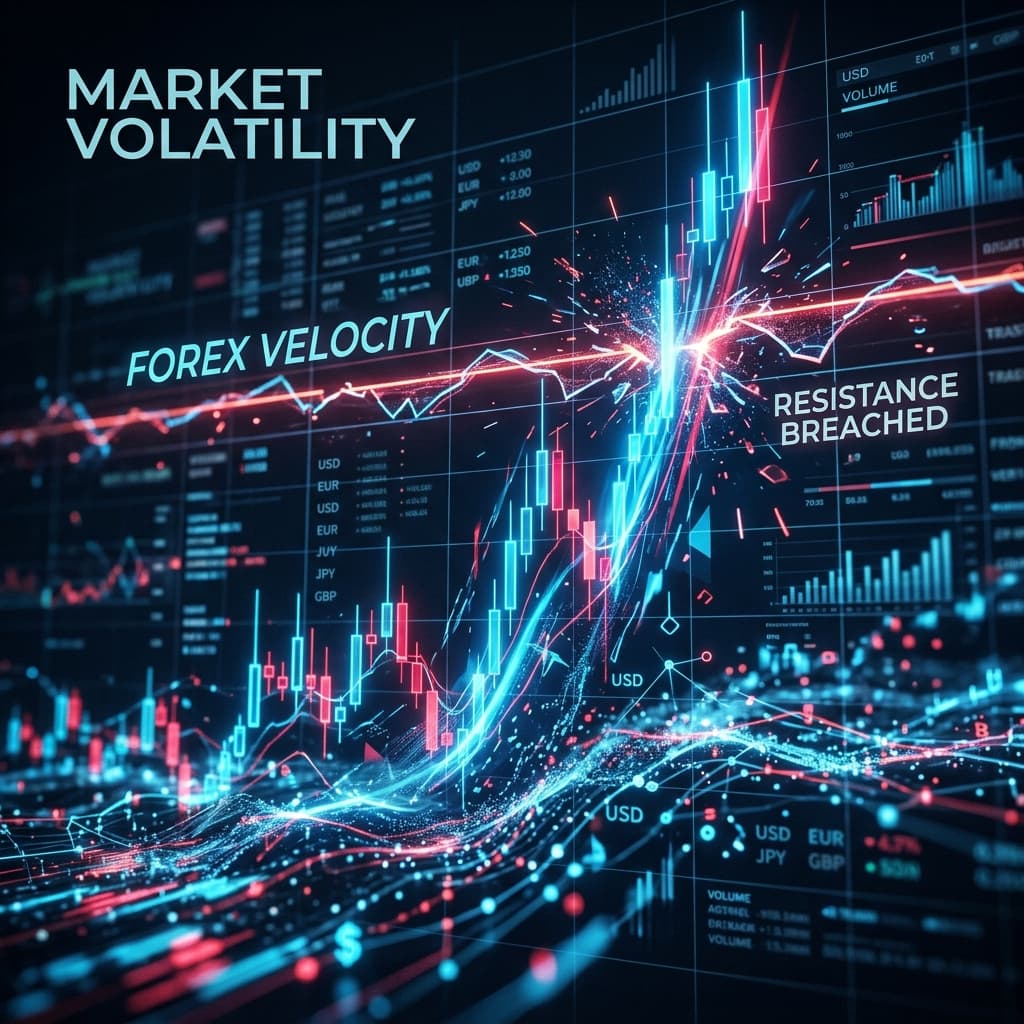
In financial terms, volatility is the statistical measure of the dispersion of returns for a given currency pair. Simply put, it is the rate at which the price of a currency increases or decreases over a specific period. * High Volatility: Price moves rapidly in wide ranges (e.g., a 150-pip swing in an hour). * Low Volatility: Price moves slowly in tight, consolidating ranges (e.g., a 20-pip r
Volatility is a double-edged sword. To the uneducated retail trader, it is the force that hits stop-losses and ruins accounts. To the professional institutional trader, volatility is the only mechanism that produces profit.
If the market doesn't move, you cannot make money. Understanding how to measure, anticipate, and harness Forex Market Volatility is what separates the professionals from the gamblers.
What is Market Volatility?
In financial terms, volatility is the statistical measure of the dispersion of returns for a given currency pair. Simply put, it is the rate at which the price of a currency increases or decreases over a specific period.
- High Volatility: Price moves rapidly in wide ranges (e.g., a 150-pip swing in an hour).
- Low Volatility: Price moves slowly in tight, consolidating ranges (e.g., a 20-pip range over an entire session).
The Three Drivers of Forex Volatility
Currency pairs do not move randomly. Volatility is injected into the market by three primary catalysts:
- Macroeconomic Data Releases: Scheduled news events like Non-Farm Payrolls (NFP), CPI inflation data, and GDP reports instantly re-price the fundamental value of a currency, causing violent price spikes.
- Central Bank Policy: Unexpected shifts in monetary policy or surprise interest rate adjustments cause massive, long-lasting volatility as global portfolios rebalance.
- Geopolitical Shocks: Unscheduled events like wars, elections, or systemic banking failures cause panic. This drives extreme volatility as capital blindly flees risk assets for safe havens like the US Dollar and Swiss Franc.
The Danger of "Choppy" Markets
The number one reason traders lose money is not because their strategy is bad, but because they deploy a trending strategy in a low-volatility, "choppy" market.
When both currencies in a pair have identical fundamental strength, they enter a tug-of-war. The EUR/USD might bounce randomly between a 30-pip range for days. Trading in this environment leads to constant false breakouts and "whipsaws."
How to Harness Volatility Using Currency Strength
To trade successfully, you need to find the pairs that have the highest probability of moving directionally. This is where Currency Strength Analysis becomes your ultimate weapon against the chop.
Instead of staring at individual charts hoping for a breakout, a macro trader uses a Live Strength Matrix to identify Extreme Divergence.
- If the GBP is experiencing high volatility to the upside (Score: 85).
- And the JPY is experiencing high volatility to the downside (Score: 15).
- The GBP/JPY pair will offer the cleanest, most directional volatility in the entire market.
You are pairing the strongest momentum with the weakest momentum, ensuring you are riding the wave rather than fighting the chop.
Frequently Asked Questions
Is high volatility dangerous? It is only dangerous if you do not use proper risk management. Professional traders actually reduce their position sizes during high-volatility events (like NFP) to maintain the same monetary risk while allowing for wider stop-losses.
Which currency pairs are the most volatile? "Exotic" pairs (like USD/MXN or USD/ZAR) and "Cross" pairs involving the British Pound and Japanese Yen (like GBP/JPY or GBP/NZD) typically exhibit the highest average daily ranges (ADR).
Which session has the highest volatility? The overlap between the London and New York sessions (13:00 GMT to 16:00 GMT) consistently produces the highest trading volume and the most directional volatility of the day.
Stop trading the chop. Find the market's true momentum leaders instantly with our institutional Live Market Dashboard.
Apply This Knowledge
See It Live on the Currency Strength Meter
Put this analysis into practice. Track real-time momentum across all 8 major currencies — free, no account needed.
Currency Strength Hub Team
CurrencyStrengthHub Editorial & Research Team
The CurrencyStrengthHub Editorial & Research Team comprises seasoned market analysts, quantitative developers, and active traders. We specialize in absolute currency strength models, global macroeconomic analysis, and creating data-driven tools for retail forex traders.