
How to Trade the Non-Farm Payrolls (NFP): A Survival Guide
NFP is the most volatile event in forex. Learn the institutional strategies to survive the spread widening, avoid slippage, and profit from the aftermath.
Quick Answer
What is the NFP?
The Non-Farm Payrolls report is released by the US Bureau of Labor Statistics. It measures the number of new jobs created in the United States during the previous month, excluding farm workers, government employees, and non-profit employees. Why does the forex market care so much about this specific report? Because employment dictates inflation, and inflation dictates interest rates. If the US ec
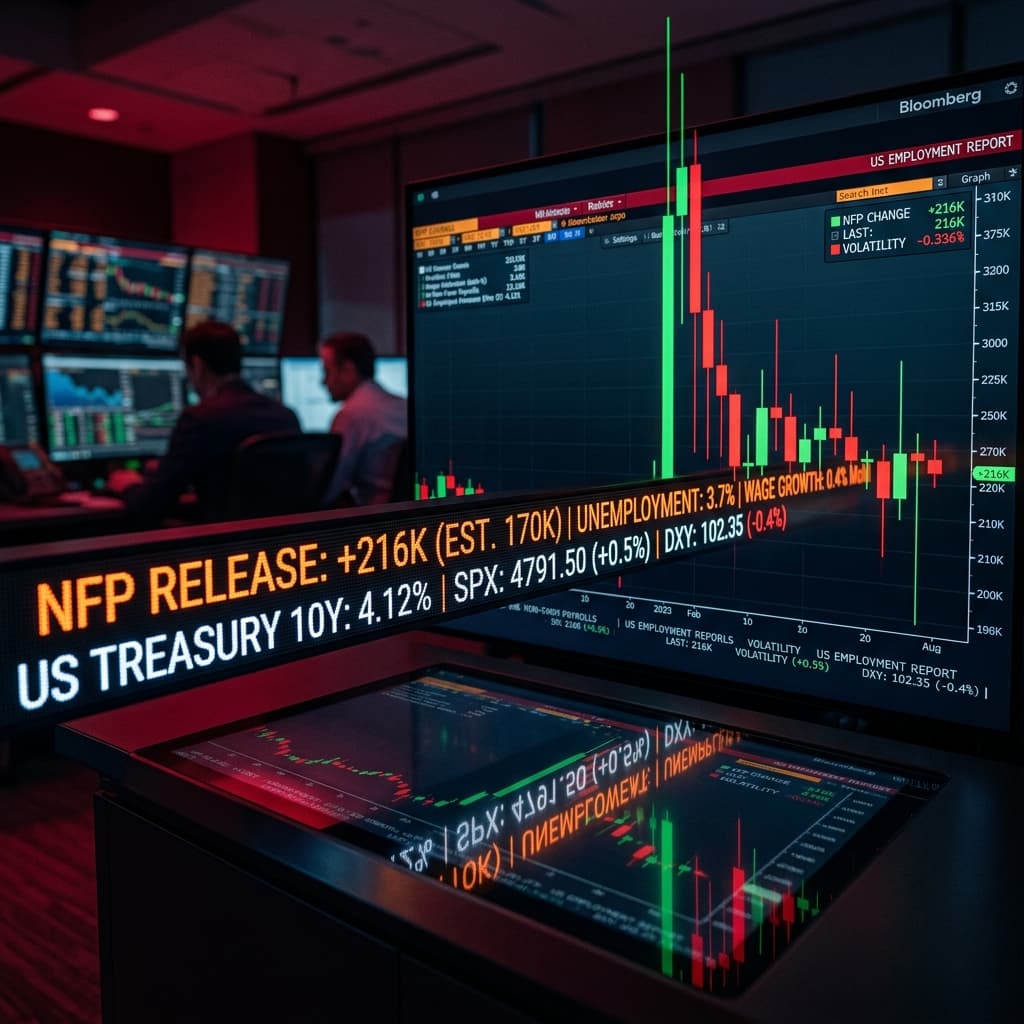
On the first Friday of every month at exactly 8:30 AM EST, the global forex market stops breathing. Liquidity dries up, spreads widen astronomically, and traders brace for impact.
This is the release of the United States Non-Farm Payrolls (NFP) report.
It is the single most volatile, dangerous, and potentially profitable economic event on the forex calendar. If you do not know how to navigate the NFP release, you can blow your entire trading account in a matter of seconds.
What is the NFP?
The Non-Farm Payrolls report is released by the US Bureau of Labor Statistics. It measures the number of new jobs created in the United States during the previous month, excluding farm workers, government employees, and non-profit employees.
Why does the forex market care so much about this specific report?
Because employment dictates inflation, and inflation dictates interest rates. If the US economy is adding a massive amount of jobs (a strong NFP), the Federal Reserve has the green light to raise interest rates to prevent the economy from overheating. A strong NFP report typically triggers massive institutional buying of the US Dollar.
The Anatomy of an NFP Release
Trading the NFP is completely different from normal technical trading. You must understand the mechanics of the order book during the release.
1. The Liquidity Vacuum (8:25 AM to 8:30 AM)
Five minutes before the release, institutional market makers pull their limit orders from the market to protect themselves from the incoming volatility. Because there are no orders left in the order book, the market suffers a severe liquidity vacuum. The spread (the difference between the bid and ask price) can instantly widen from 1 pip to 30 pips.
2. The Initial Spike (8:30:00 AM to 8:30:15 AM)
The data drops. High-frequency trading (HFT) algorithms instantly process the deviation between the "Forecast" and the "Actual" number and execute billions of dollars in market orders in milliseconds. Because liquidity is so low, the price violently gaps up or down 50 to 100 pips in a single second.
3. The Whipsaw (8:31 AM to 8:40 AM)
The initial spike is rarely the true direction of the market. Often, the algorithms intentionally spike the price in the wrong direction to trigger retail stop-losses (a liquidity grab). The price will then violently reverse, creating massive "whipsaw" candles that destroy traders in both directions.
Professional NFP Strategies
Amateur traders try to guess the NFP number and place trades at 8:29 AM. Professional traders use strategies designed to survive the chaos and trade the reality.
Strategy 1: The Sideline (The Safest Route)
The most common institutional strategy for NFP is to simply not trade it. Close all open positions on Thursday night. Wait for the Friday chaos to end, and resume trading on Monday when spreads are normal and the macro trend has been established.
Strategy 2: Trading the Fade
Wait for the initial 8:30 AM algorithmic spike to occur. Often, this spike hits a major structural resistance or support level on the daily chart. Once the initial surge loses momentum, professional traders "fade" the move, betting that the price will retrace back to its pre-NFP origin point.
Strategy 3: The Aftermath Trend (Recommended)
Do not touch your mouse until 8:45 AM EST. Let the algorithms fight, let the spreads return to normal, and let the market digest not just the headline NFP number, but also the accompanying Unemployment Rate and Average Hourly Earnings data.
At 8:45 AM, open the Live Currency Strength Dashboard. If the USD is showing an absolute strength score of 85+ and the EUR is showing a score of 15-, the institutional trend for the day has been established. Enter a trade in the direction of the confirmed momentum on the first 5-minute pullback.
Frequently Asked Questions
Can I use a Stop-Loss during NFP? Yes, but it might not work. Because of the liquidity vacuum, if the price gaps past your Stop-Loss, your broker will suffer Slippage and execute your trade at the next available price, which could result in a loss far greater than you intended.
Which pairs are best to trade during NFP? You must trade pairs with the absolute highest liquidity to minimize slippage. The EUR/USD and USD/JPY are the only pairs recommended for trading the NFP aftermath. Never trade exotic pairs during this event.
Don't gamble on the news. Wait for the dust to settle, verify the true institutional momentum on our Live Market Dashboard, and trade the aftermath with confidence.
Apply This Knowledge
See It Live on the Currency Strength Meter
Put this analysis into practice. Track real-time momentum across all 8 major currencies — free, no account needed.
Currency Strength Hub Team
CurrencyStrengthHub Editorial & Research Team
The CurrencyStrengthHub Editorial & Research Team comprises seasoned market analysts, quantitative developers, and active traders. We specialize in absolute currency strength models, global macroeconomic analysis, and creating data-driven tools for retail forex traders.