
Forex Market Structure: Accumulation vs Distribution
Understand the hidden architecture of the forex market. Learn how to identify institutional accumulation and distribution zones before massive trends begin.
Quick Answer
The Four Phases of Market Structure
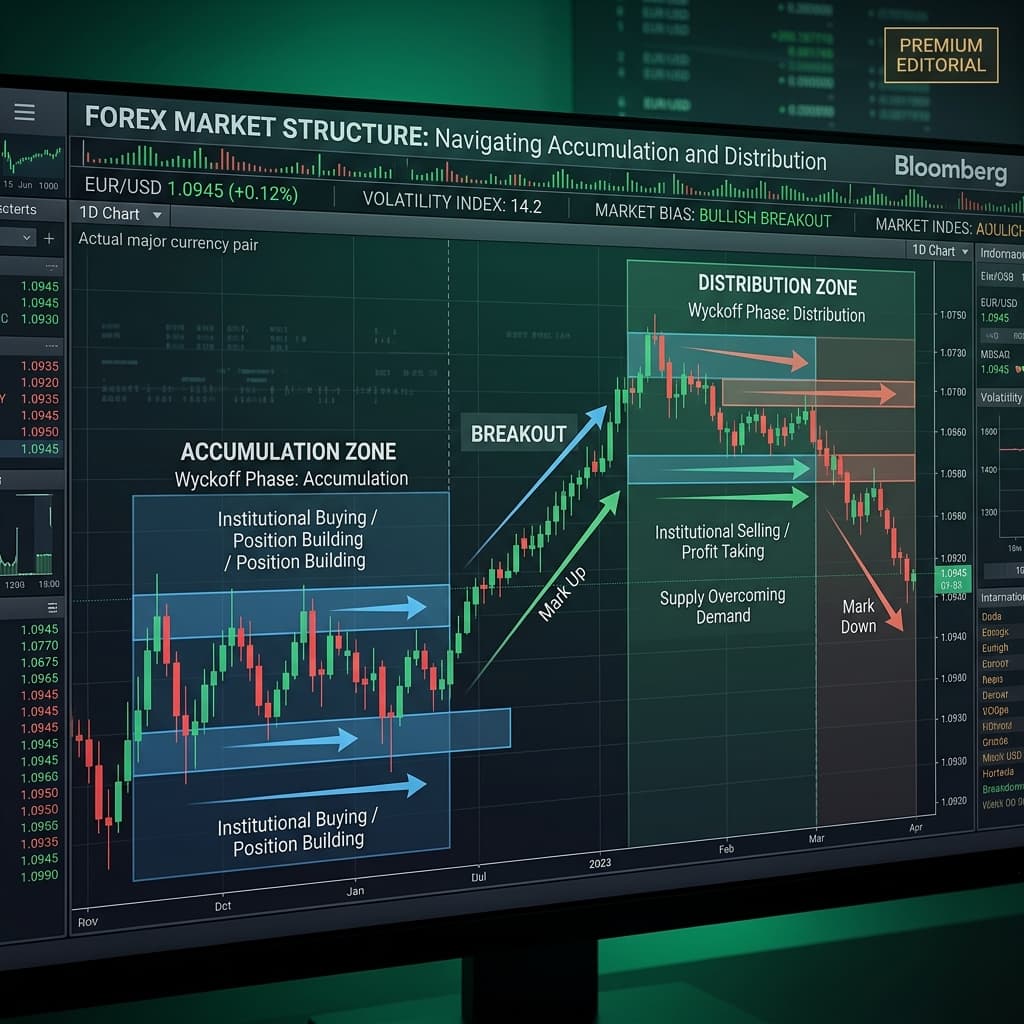
The institutional market cycle is broken down into four distinct phases. This cycle repeats on every timeframe, from the 5-minute chart to the Monthly chart. After a long downtrend, the market enters a sideways, "choppy" range. This is the Accumulation phase. Retail traders get frustrated here because breakouts constantly fail. What is actually happening? Institutional algorithms are quietly buyi
If you open a blank forex chart and only see a random sequence of green and red candles, you are blind to the true architecture of the market.
The forex market does not move randomly. It moves through a rigid, cyclical structure dictated by the enormous capital requirements of institutional players (banks, hedge funds, and liquidity providers). Because they manage billions of dollars, they cannot enter or exit the market all at once. They must move the market in phases.
Understanding these phases is the essence of Market Structure Analysis.
The Four Phases of Market Structure
The institutional market cycle is broken down into four distinct phases. This cycle repeats on every timeframe, from the 5-minute chart to the Monthly chart.
Phase 1: Accumulation (The Foundation)
After a long downtrend, the market enters a sideways, "choppy" range. This is the Accumulation phase. Retail traders get frustrated here because breakouts constantly fail. What is actually happening? Institutional algorithms are quietly buying massive amounts of currency. Because their order sizes are so large, they have to buy slowly over weeks or months to avoid spiking the price too early. They "accumulate" their position within this horizontal range.
Phase 2: Markup (The Trend)
Once the institutions have finished accumulating their positions, they remove their sell limit orders. Suddenly, there is no resistance left in the market. The price breaks out of the accumulation zone and trends aggressively upward. This is the "Markup" phase. This is where trend traders make all their money.
Phase 3: Distribution (The Ceiling)
After a massive uptrend, the institutions are sitting on billions in profit, but they have a problem: how do they sell billions of dollars without crashing the price? They create another horizontal range at the top of the trend. As retail traders continue to enthusiastically buy the top (FOMO), the institutions quietly sell their positions to them. They "distribute" their holdings.
Phase 4: Markdown (The Crash)
Once the institutions have sold their entire position, they step aside. With no major buyers left to support the market, gravity takes over. The price breaks down through the floor of the distribution zone and trends aggressively lower.
Identifying the Phases Using Currency Strength
How do you know if a sideways range is an Accumulation zone (meaning price will go up) or a continuation pattern (meaning price will go down)?
You don't need to guess. You can use absolute momentum data. If the EUR/USD is stuck in a sideways range on the 4-hour chart, look at the Live Currency Strength Dashboard.
- If the EUR strength score is steadily rising from 20 to 60 over several days despite the price moving sideways, that is Mathematical Accumulation. The smart money is buying.
- If the EUR strength score is dropping while the price is sideways, that is Distribution. The smart money is selling.
The "Spring" (Liquidity Grab)
One of the most devious institutional tactics occurs at the very end of the Accumulation phase.
Just before the massive upward trend begins, the market will suddenly spike below the accumulation zone. Retail traders panic and sell, hitting their stop-losses. This massive wave of retail selling provides the exact liquidity the institutions need to fill their final massive buy orders. This false breakdown is known as a "Spring" or "Liquidity Grab." Once the liquidity is taken, the price reverses violently upward.
Frequently Asked Questions
Does this cycle happen on all timeframes? Yes. Market structure is fractal. You can see accumulation and distribution phases on a 1-minute chart (lasting hours) and on a Weekly chart (lasting years).
Why do retail traders always buy at the top? Human psychology. By the time the Markup phase is clearly visible to everyone, the trend is usually nearing its end. Retail traders experience FOMO (Fear Of Missing Out) and buy right as the institutions enter the Distribution phase.
What is the best phase to trade? The most profitable trading strategy is to wait for the Accumulation phase to end, survive the "Spring" liquidity grab, and buy the exact moment the Markup phase breaks the structural high.
Stop guessing the market structure. Detect institutional accumulation in real-time by tracking absolute currency momentum on our Live Market Dashboard.
Apply This Knowledge
See It Live on the Currency Strength Meter
Put this analysis into practice. Track real-time momentum across all 8 major currencies — free, no account needed.
Currency Strength Hub Team
CurrencyStrengthHub Editorial & Research Team
The CurrencyStrengthHub Editorial & Research Team comprises seasoned market analysts, quantitative developers, and active traders. We specialize in absolute currency strength models, global macroeconomic analysis, and creating data-driven tools for retail forex traders.